
payless.host
Domains and Business Email: What You Need and What It Costs
Updated Nov 22, 2026
What a Domain and Business Email Actually Are
A domain is the address people type to reach your site—yourname.com rather than yourname.hostingcompany.com. Business email means messages sent from that domain: you@yourcompany.com instead of yourcompany@gmail.com. The two are sold separately, sometimes together, and either can be bought without the other.
A domain is registered through a registrar, renewed annually, and costs between a few dollars and several hundred depending on the extension. Business email is a service billed monthly or yearly, priced per mailbox, and hosted either by the domain registrar or a third party.
Who Needs a Domain
Anyone running a business under their own name needs a domain. A customer who sees yourname.wixsite.com or yourname.wordpress.com reads it as a temporary project, not a business they can rely on next year. The same applies to anyone taking payment, offering a service for hire, or asking a stranger to trust them with information.
A domain is also what search engines index. A site on a subdomain—yours.provider.com—competes for ranking with every other subdomain under provider.com. A site on its own domain does not.
You do not need a domain if the project is personal, short-term, or exists only to test an idea. A blog about a hobby does not require one. A portfolio shown to people you already know does not require one. A landing page collecting emails for a product that may never ship does not require one.
Who Needs Business Email
Business email matters when the person receiving your message decides whether to reply based on the address it came from. A supplier, a client, a journalist, or anyone who gets fifty pitches a day will not open one from companyname84@gmail.com.
The mailbox itself functions the same as a free one—it sends and receives messages, supports attachments, and works with the same apps. What you are paying for is the From line. That line either signals that you run a business or that you do not.
You do not need business email if everyone you correspond with already knows you, if you are applying for jobs rather than hiring, or if the work happens entirely on platforms with their own messaging—Upwork, Etsy, eBay.
What It Costs
A .com domain at Namecheap costs $6.79 per year on the NEWCOM679 offer, and that price does not change at renewal. A .net domain starts at $11.68 under the NETDEAL1168 promo, then renews at $14.98 after twelve months, reaching $499.68 over three years. A .co domain costs $19.98 in year one, then $38.48 annually, totalling $1,163.28 across three years.
The domain extension determines the price, and the promo determines whether the renewal rate differs from the first-year rate. Extensions like .online cost $0.98 in year one at Namecheap, renew at $2.88, and reach $80.88 over three years. Extensions like .dev cost $10.98 initially, renew at $15.98, and total $515.28 over the same period.
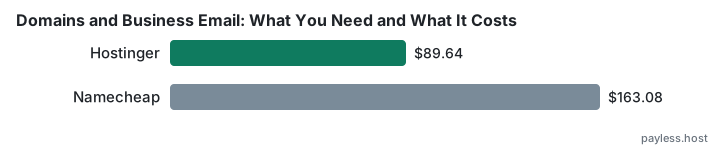
Business email at Namecheap begins with a free trial under Private Email, then costs $1.24 per month, totalling $43.40 over three years. Hostinger runs a deal where buying two mailboxes on an annual plan includes a third mailbox at no charge.
How to Choose a Domain
Choose the extension that matches what people expect to type. A business in the United States uses .com unless the name is already taken. A business in the European Union can use .eu, which at Namecheap costs $6.98 in year one and renews at $8.98. A developer or technology business can use .dev, which costs $10.98 initially and renews at $15.98.
Avoid extensions chosen only because they are cheap. A .online domain costs less than a dollar in year one, but a customer who sees it will assume the business could not afford the .com. The savings disappear the moment someone doubts whether the site is legitimate.
Buy the domain where you intend to manage it. Registrars that also sell hosting—Hostinger, Namecheap—allow the domain and hosting account to be administered in one place. Registrars that specialise in domains often provide better search tools and bulk management features. Transferring a domain later is possible but adds a step and a fee. A .com transfer at Namecheap costs $11.48, then renews at $14.98, reaching $497.28 over three years.
How to Choose Business Email
Business email is priced per mailbox, so the decision is how many people need to send from the company domain. A sole trader needs one. A business with employees needs one per person who communicates with customers or suppliers.
Some hosts bundle email with hosting plans; others sell it separately. Bundling saves a step in setup but ties the email service to the hosting contract. If the hosting is cancelled, the email stops unless migrated. Buying email separately—through Namecheap's Private Email or a provider like Google Workspace—means the email continues regardless of where the site is hosted.
Hostinger offers free AI email marketing for one year on its Unlimited plan and doubles AI credits during Black Friday promotions. These are add-ons to the hosting service, not replacements for a mailbox.
The Mistakes People Make
The most common mistake is registering a domain, then forgetting to renew it. Domains do not auto-renew unless payment details are current, and a lapsed domain can be bought by someone else the day it expires. Set the renewal to automatic or add a calendar reminder sixty days before expiry.
The second mistake is choosing a domain that cannot be spelled aloud. If you cannot dictate the name over the phone without repeating letters or explaining which homophone you mean, the domain will cost you customers. A name with a number, a hyphen, or an ambiguous spelling is a name that requires the person typing it to already know what it is.
The third mistake is paying for features that do not apply. Domain privacy, which hides your address from the public WHOIS database, is worth having. Domain forwarding, website builders, and SSL certificates bundled with a domain registration are usually either free elsewhere or unnecessary.