
payless.host
Hosting for beginners: what it costs and how to choose
Updated Nov 22, 2026
What hosting is
Web hosting is the service that makes a website visible on the internet. A hosting provider stores your site's files on a server and delivers them to anyone who types in your address. Without hosting, a domain name points nowhere.
The service includes server space, bandwidth to handle visitors, and usually an email address tied to your domain. Most providers also supply a control panel for uploading files, managing databases, and adjusting settings without needing to understand the server itself.
Who needs it
Anyone running a website on their own domain needs hosting. That includes small business sites, portfolios, blogs, and online stores. If you are using a platform like Wix or Squarespace, hosting is included in what you pay them — you do not buy it separately.
You also do not need standalone hosting if you are only registering a domain for future use, or if you are running a site through a marketplace builder that handles infrastructure for you.
Who does not
Social media profiles, LinkedIn pages, and sites built entirely inside a platform's ecosystem do not require separate hosting. Neither do projects still in development on your own computer. Hosting becomes necessary when you want a site live under a domain you control.
What it costs
Shared hosting — where your site sits on a server alongside others — is what most beginners need, and introductory prices start low. HostGator charges 3.75 USD/month for its Hatchling plan if you commit to three years upfront. DreamHost offers Web Hosting Launch at 2.89 EUR/month for the first year. SherlockHost charges 2.49 GBP/month and holds that price through renewal.
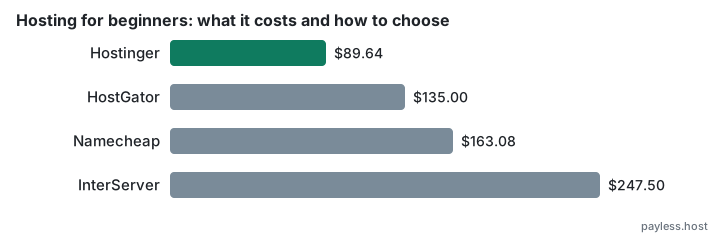
The gap between what you pay first and what you pay later decides the real cost. HostGator's Hatchling plan totals 135.00 USD over three years, but renews at 10.99 USD/month after the initial term — nearly triple the intro rate. DreamHost's equivalent renews at 10.99 EUR after twelve months, bringing the three-year total to 298.44 EUR. SherlockHost's 2.49 GBP/month does not change, which makes it cheaper than most alternatives here, though the listing of unlimited resources on that plan makes it difficult to verify what you are guaranteed.
InterServer starts at 2.50 USD/month for one month, then renews at 7.00 USD/month unless you prepay annually. The three-year total of 247.50 USD lands in the middle, but the monthly renewal rate after the intro period is the highest among shared hosts listed here.
Hostinger offers Cloud Professional at 15.99 USD/month, with a three-year total of 575.64 USD. The provider does not state a renewal price for that plan. Its cloud GPU options — aimed at intensive workloads rather than typical websites — run from 0.42 USD/hour for an RTX 4090 to 7.08 USD/hour for a dedicated B200, all at the same price through renewal.
Managed WordPress hosting costs more but removes technical maintenance. DreamHost's DreamPress 1 plan starts at 14.99 EUR/month, renews at 19.99 EUR, and totals 659.64 EUR over three years — a smaller jump than on the shared plan.
How to choose
Start with what the plan includes. Check storage limits, the number of sites allowed, and whether email accounts are part of the package. A plan that permits only one site will not work if you later want to run a second domain.
Then calculate what you will pay beyond the first term. A provider that charges 3 USD/month for three years then 12 USD/month after is more expensive than one that charges 6 USD/month from the start. Multiply the renewal rate by the months you expect to keep the site running. Most people keep a site longer than three years.
Support structure matters when something breaks. Look for whether help is available through chat, phone, or only ticketed email, and whether it runs around the clock or within business hours.
Decide whether prepaying for multiple years fits your situation. Committing upfront locks in a lower rate but means paying more now and losing that money if you cancel early. Monthly billing costs more per month but allows you to leave without forfeiting a year's fees.
Mistakes people make
The most common mistake is choosing on the monthly intro price and ignoring what it renews at. A plan advertised at 2.99 per month can cost 467.64 over three years once the rate changes. Always do the arithmetic.
Buying more than you need is the second. A site expecting a few hundred visitors a month does not require a VPS plan costing ten times what shared hosting does. Start with shared hosting and move up only when traffic or resource use justifies it.
Relying on unlimited claims without reading the terms is the third. Providers that advertise unlimited storage or bandwidth usually define acceptable use in ways that prevent you from treating "unlimited" as infinite. Look for stated limits instead.
Finally, ignoring renewal rates on add-ons. Namecheap offers a .online domain at 0.98 USD/year, but it renews at 2.88 USD after the first year, with a three-year total of 80.88 USD. A .co domain starts at 19.98 USD/year and renews at 38.48 USD, totaling 1163.28 USD over three years. The gap is significant, and it applies to privacy protection, SSL certificates, and every other line item that renews at a different rate from the one you paid upfront.