
payless.host
Email for Your Domain: What It Is, Who Needs It, and What It Costs
Updated Nov 22, 2026
What email for your domain actually is
Email for your domain means messages arrive at your‑name@your‑company.com instead of your‑name@gmail.com. The technical difference is that the domain after the @ symbol belongs to you. The practical difference is that a custom address presents as a business rather than as someone using a free consumer service.
The email itself—storage, spam filtering, the interface you type into—runs on a provider's infrastructure. You own the address; they run the server.
Who needs it and who does not
A business sending invoices, quotes, or contracts needs a domain email address. A customer who receives an estimate from jane.doe1983@hotmail.com has been given a reason to doubt whether the business is a business. The same applies to anyone whose work depends on strangers trusting them: consultants, freelancers, trades.
A personal blog or hobby project does not need it. Neither does a portfolio site where communication happens through a contact form. Paying for a custom email address when all correspondence could run through a free service is paying for a signal nobody is looking for.
The same domain can host a website and handle email through different providers. The two are independent.
What it costs
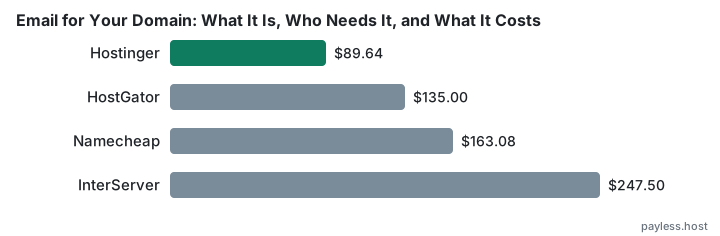
Namecheap offers Private Email with a free trial, then 1.24 USD per month from the second month, reaching 43.40 USD over three years. That is among the lowest standalone email costs.
Many hosting providers include email as part of a shared hosting package, though at widely varying prices. Hostinger currently offers a deal where annual business email plans receive a third mailbox free, and certain plans include free AI email marketing for one year. HostGator includes email with shared hosting that starts at 3.75 USD per month on the Hatchling plan, though the price becomes 10.99 USD after thirty‑six months.
DreamHost bundles email with its Web Hosting Launch plan at 2.89 EUR monthly, rising to 10.99 EUR after twelve months, for a three‑year total of 298.44 EUR. InterServer starts at 2.50 USD per month, moving to 7.00 USD after the first month—the highest monthly rate after an introductory period among the providers supplying pricing here.
SherlockHost holds at 2.49 GBP per month from signup through year three on its Web Hosting plan, which includes email.
Where a hosting package includes email and you need hosting anyway, the email carries no separate cost. Where you already have hosting elsewhere or need only email, a standalone service is cheaper than paying for hosting you will not use.
How to choose
Start with how many addresses the business needs. A sole trader needs one. A company with four people needs four, or more if roles like info@ and support@ are separate addresses rather than aliases.
Storage matters if email accumulates. A mailbox that holds two years of client correspondence with attachments needs more space than one that handles appointment confirmations. Providers state storage per mailbox; check what happens when it fills—whether old messages are deleted, new ones rejected, or additional space available.
Access method depends on how email is used. Webmail works from any browser. IMAP and POP3 connect to Outlook, Thunderbird, or a phone's mail app. Most providers offer both; a few offer only webmail.
Support structure becomes relevant when email stops working. A business that cannot receive orders while waiting for a ticket response needs phone or live chat support. Someone sending three messages a week can wait.
Mistakes that waste money
Buying a hosting plan for email alone when standalone email costs a tenth as much is the most common error. Hosting is infrastructure for a website; email is a feature some hosting includes. Paying for the former to obtain the latter is paying for the wrong thing.
Prepaying multiple years to lock in an introductory rate saves money only if the business will still need the service at renewal. A project that might not last two years should pay monthly.
Adding mailboxes you do not use costs more than adding them later when you do. Email for four theoretical future employees is email you are paying for now.
Ignoring where the price rises and when it does leaves you surprised by a bill. Namecheap's Private Email is free for one month, then 1.24 USD. DreamHost's hosting with email is 2.89 EUR for twelve months, then 10.99 EUR. The three‑year total tells you what you will actually spend; the monthly intro price does not.
What you are buying
A custom email address buys credibility in contexts where it is looked for. It does not buy better spam filtering, more storage, or a superior interface than the free services most people already use for personal mail. The case for it is the signal it sends, not the features it contains. Where the signal matters, the cost is justified. Where it does not, the cost is not.