
payless.host
Cloud hosting: costs, who it suits, and how to choose
Updated Nov 22, 2026
What cloud hosting is
Cloud hosting runs your site or application on a pool of servers instead of a single physical machine. Resources such as CPU, memory and storage are allocated to you as needed, and you pay for what you use or for a defined bundle of capacity.
With traditional shared hosting, many customers share one server on a fixed monthly plan. With cloud hosting you are closer to infrastructure: you can scale up and down more flexibly, often by changing instance size or adding capacity without moving to a different machine.
Who cloud hosting is for
Cloud hosting suits projects where demand is uncertain or can change quickly.
If you are training AI models or running GPU‑heavy workloads, the cloud products at Hostinger are an example of what this looks like in practice. Their RTX 4090 cloud plans are 0.42 USD/hour, with the same price at renewal. Higher‑end options such as B200 and B200 GPU cloud plans are 4.50 USD/hour, also with the same price at renewal. These are aimed at compute‑intensive tasks where you scale resources up and down as jobs start and finish.
Cloud hosting also suits teams that want to script or automate their infrastructure, or to separate environments for development, staging and production without committing to long shared‑hosting terms.
Who does not need cloud hosting
Many smaller sites do not need this level of control.
A simple brochure site or small blog is often cheaper and easier to run on shared hosting. For example, SherlockHost prices its entry plans, such as Website Builder, Linux Hosting start and Web Hosting, at 2.49 GBP/month with the same price at renewal. The monthly cost stays at that level from signup through year three. For a straightforward site, that can be more predictable than usage‑based cloud billing.
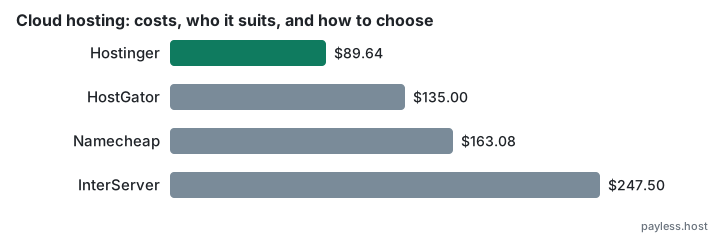
InterServer has a Standard Web Hosting plan at 2.50 USD/month, renewing at 7.00 USD after 1 month, with a three‑year total of 247.50 USD. This is still structured as shared hosting rather than cloud, and suits people who want a single, long‑running site without managing infrastructure details.
If you mainly want a domain name and basic email, cloud hosting is also more than you need. Namecheap focuses on domains, with offers such as a .com domain registration at 6.79 USD/year with the same price at renewal, and Private Email with a free trial that renews at 1.24 USD/month, with a three‑year total of 43.40 USD.
How cloud hosting is priced
Cloud pricing comes in two broad forms: pay‑by‑the‑hour and fixed monthly terms.
At Hostinger, the cloud products listed are hourly. RTX 5090 and RTX 5090 GPU cloud plans are 0.64 USD/hour, RTX PRO 6000 (Server) and RTX PRO 6000 (Server) GPU are 0.65 USD/hour, L40S and L40S GPU are 0.96 USD/hour, A100 and A100 GPU are 1.55 USD/hour, and B200 and B200 GPU are 4.50 USD/hour. All of these keep the same price at renewal. This kind of pricing is suitable when instances may only run for a few hours or days.
On the other side, some providers sell higher‑powered plans as part of their regular hosting ranges. DreamHost has VPS Business at 13.75 EUR/month, renewing at 31.99 EUR after 12 months, with a three‑year total of 932.76 EUR. DreamPress 1 is 14.99 EUR/month, renewing at 19.99 EUR after 12 months, with a three‑year total of 659.64 EUR. These are monthly plans with defined resources rather than per‑hour billing, closer to traditional hosting in how you pay.
Shared hosting can be much cheaper per month, particularly on long initial terms. HostGator prices its Hatchling shared plan at 3.75 USD/month, renewing at 10.99 USD after 36 months, with a three‑year total of 135.00 USD. The Business plan is 6.25 USD/month, renewing at 21.99 USD after 36 months, with a three‑year total of 225.00 USD. These are not cloud plans, but they show the difference between a low, long‑term introductory rate and the later renewal price.
How to decide if cloud hosting is worth it
Start with how your application behaves. If you expect steady, modest traffic and a single site, fixed‑price shared hosting from providers like SherlockHost or InterServer can often cover what you need.
If you expect traffic to change sharply, or you run short‑term, intensive jobs, the hourly pricing at Hostinger gives you direct control over when instances are running and what they cost per hour. Because RTX 4090, RTX 4090 GPU, RTX 5090, RTX 5090 GPU, RTX PRO 6000 (Server), RTX PRO 6000 (Server) GPU, L40S, L40S GPU, A100, A100 GPU, B200 and B200 GPU all keep the same price at renewal, you can plan around those fixed hourly rates.
Consider the support and extras as part of the spend. SherlockHost includes a 30‑day money‑back guarantee on UK hosting and Windows hosting, free website transfer on UK web hosting, and 7‑day free trials on UK web hosting and Windows hosting plans. If you are moving from shared hosting towards more complex setups, these kinds of services can matter as much as raw compute price.
Deals and long‑term commitments
Some providers focus on discounts for long commitments rather than usage‑based cloud.
Hostinger promotes deals such as “Buy 2 mailboxes get 1 free” on annual business email, 67% off 48‑month Premium business email, 75% off 48‑month Standard business email, Black Friday 2x AI credits on the Agency Startup plan, and discounted VPS hosting for Black Friday. These offers sit alongside the hourly cloud pricing and are aimed at customers ready to prepay for email or VPS services.
Namecheap has several domain promotions: a .online domain registration promo at 0.98 USD/year renewing at 2.88 USD after 12 months, with a three‑year total of 80.88 USD; a .eu domain registration promo at 6.98 USD/year renewing at 8.98 USD after 12 months, with a three‑year total of 299.28 USD; a .dev domain registration promo at 10.98 USD/year renewing at 15.98 USD after 12 months, with a three‑year total of 515.28 USD; and others across .us, .com, .net, .org, .me and .co domains. These show how a low first‑year price can move to a higher rate in later years.
Common mistakes with cloud hosting
One mistake is treating an introductory or trial price as the long‑term cost. DreamHost prices Web Hosting Launch at 2.89 EUR/month, renewing at 10.99 EUR after 12 months, with a three‑year total of 298.44 EUR. VPS Business and DreamPress 1 have similar structures with higher renewal prices after the first year. HostGator holds its intro prices for 36 months before renewal, but the renewal rates on Hatchling, Baby, Business and Pro are much higher than the first‑term prices.
Another mistake is choosing infrastructure you do not plan to manage. Hourly GPU instances such as the A100 or B200 plans at Hostinger fit teams that can monitor usage and turn instances off when they are idle. If you prefer to set up a site once and then rarely touch it, fixed‑price shared plans such as the Linux Hosting start plan at SherlockHost at 2.49 GBP/month or Standard Web Hosting at InterServer may suit you better.
A third mistake is forgetting add‑ons. Domains, email and migration all add to the total. Namecheap bundles domain promotions and email trials; SherlockHost includes a free website transfer service on UK web hosting. When you compare cloud hosting to shared hosting, include these services alongside the raw compute price.