
payless.host
SEO and Your Host: What It Is, Who Needs It, and What It Costs
Updated Nov 22, 2026
What SEO Hosting Claims to Be
SEO hosting is sold as shared hosting optimised for search rankings. Providers claim dedicated IP addresses, faster servers, better uptime, and infrastructure tuned to what search engines reward. The pitch is that your site will rank higher because the hosting itself is built for SEO.
What you actually get varies. Some providers offer Class C IP ranges so multiple sites appear to come from different networks. Others include speed-focused caching, content delivery networks, or server configurations meant to improve load times. A few bundle keyword tools or analytics. Most charge more than standard shared hosting.
Who Needs It and Who Does Not
Most sites do not need SEO hosting. A standard shared host with decent uptime and reasonable load times will not hurt your rankings. Search engines care about content, page structure, and links — things controlled in your CMS, not your hosting control panel. If your site loads in three seconds rather than two, the ranking difference is marginal at best.
SEO hosting makes sense in two situations. The first is when you run multiple sites and want them on different IP addresses to avoid looking like a link network. Shared hosting puts dozens of sites on one IP; SEO hosting separates them. The second is when speed genuinely matters — an ecommerce site where a half-second delay costs conversions, or a news site competing on breaking stories. Even then, you are paying for performance, not SEO.
What It Costs
SEO hosting is not a separate category on most pricing pages. Providers fold it into managed WordPress plans, premium shared tiers, or VPS packages marketed with SEO language.
DreamHost charges 14.99 EUR per month for DreamPress 1, a managed WordPress plan that includes caching and staging tools, then 19.99 after twelve months. The three-year total is 659.64 EUR. That is higher than basic shared hosting but includes migration, daily backups, and infrastructure meant to keep a WordPress site fast.
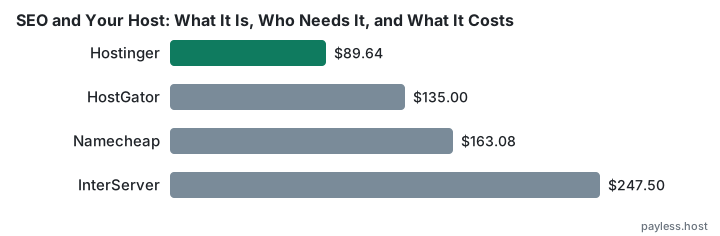
HostGator offers a Business plan at 6.25 USD per month for the first three years, renewing at 21.99. The three-year total is 225.00 USD, and the plan includes a dedicated IP and SEO tools bundled into the control panel. The gap between intro and renewal is wide — more than triple — but the total lands mid-table.
Standard shared hosting costs less. SherlockHost charges 2.49 GBP per month for Linux Hosting, the same price at renewal. That is cheaper than nearly everything here, though claims of unlimited resources make it hard to judge what you actually get. InterServer starts at 2.50 USD per month for Standard Web Hosting, renews at 7.00 after one month, and totals 247.50 USD over three years. The monthly rate after intro is the highest among the providers here, but the first month is low enough to test without commitment.
How to Choose
Start with what problem you are solving. If your site is slow, check whether hosting is the cause before paying for a faster plan. A poorly optimised theme or uncompressed images will drag load times no matter what server you are on. Run the site through a speed test and see where the delay sits. If it is in server response time, hosting might be the fix. If it is in render-blocking scripts or oversized files, it is not.
If you need a dedicated IP, check whether your current host offers one as an add-on. Many shared hosts sell them for a few dollars a month, far cheaper than moving to an SEO-specific plan. If you need multiple IPs across different Class C ranges, that is when SEO hosting or a VPS becomes the practical choice.
For managed WordPress hosting marketed as SEO-ready, compare what is included against what you would add yourself. If the plan bundles a CDN, caching, staging, and automatic updates, and you were going to pay for those separately, the premium may be worth it. If it is just shared hosting with "SEO" in the name, it is not.
The Mistakes People Make
The biggest mistake is buying SEO hosting when standard hosting would work. A site that gets fifty visitors a day does not need a dedicated IP or enterprise caching. The ranking difference will be invisible, and the money would do more spent on content or links.
The second mistake is assuming hosting alone improves rankings. It does not. A fast host helps, but only if the site itself is built to load quickly. A slow theme on a fast server is still slow. Search engines rank pages, not servers.
The third mistake is choosing a host based on features you will not use. SEO tools bundled into a control panel are only valuable if you open them. Keyword tracking, backlink monitors, and site audits are offered by free standalone tools that often work better than the hosting add-ons. Pay for what you will actually need, not what sounds useful in a feature list.
SEO hosting exists because search rankings matter and people will pay for an edge. Most of the time, that edge is elsewhere — in the content, the links, the page structure. Hosting contributes, but only once those other pieces are in place. If your site is slow or you need dedicated IPs, the investment makes sense. If you are hoping hosting will fix rankings on its own, it will not.