
payless.host
Website Speed and Hosting: What Makes Sites Fast
Updated Nov 22, 2026
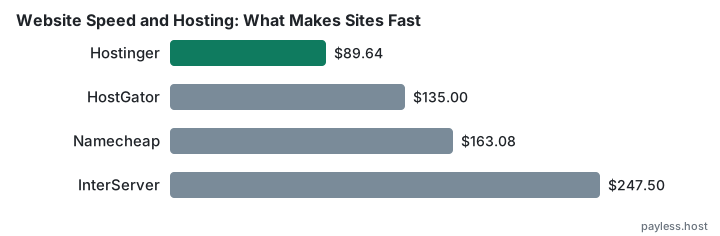
What determines site speed
Hosting affects how quickly a server responds, not how quickly a page loads. A fast host cuts 50 milliseconds off the time to first byte; a badly written page adds three seconds. The hosting matters, but it is not where most speed problems live.
Three things in hosting control speed: the distance between server and visitor, whether the host uses solid-state drives, and how many sites share the server's resources. Beyond that, the site itself — image sizes, script weight, caching — decides the number.
Server location and content delivery
A server in London responds to a London visitor in 20 milliseconds and to a Sydney visitor in 280. Physics sets the floor. Providers handle this in two ways: multiple data centre locations, or a content delivery network that caches files closer to the visitor.
Shared hosting usually comes with one server location. DreamHost includes Cloudflare CDN on its Web Hosting Launch plan at 2.89 EUR/month, rising to 10.99 after twelve months. HostGator offers CDN as an add-on rather than including it; the Hatchling plan starts at 3.75 USD/month and renews at 10.99 after thirty-six months.
A CDN matters for sites with visitors spread across continents. For a local business serving one city, the cost is not justified.
Storage type and server resources
Solid-state drives respond in microseconds where spinning disks take milliseconds. Every shared host here uses SSDs now; it is not a differentiator. What varies is how many sites share the CPU and memory.
Shared hosting puts hundreds of sites on one server. The cheap end — SherlockHost at 2.49 GBP/month, same price at renewal — claims unlimited resources but does not define what that means under load. The expensive end allocates fixed resources: DreamHost DreamPress 1 at 14.99 EUR/month, renewing at 19.99, is a managed WordPress plan on isolated infrastructure.
A VPS gives you a defined slice of a server. DreamHost VPS Business starts at 13.75 EUR/month and renews at 31.99, three-year total 932.76 EUR. You are guaranteed the memory and CPU you pay for, regardless of what neighbouring sites do.
Caching and database performance
Most shared hosts cache static files — images, stylesheets, scripts — so they are served without hitting the application. WordPress sites also cache rendered pages. The host provides the mechanism; you or your CMS configures it.
DreamPress includes server-level caching tuned for WordPress. Generic shared hosting requires a caching plugin. Either works if set up correctly, but the managed option removes a step.
Database speed depends on the same resource sharing as everything else. A slow query on a cheap shared plan affects every other site on the server. On a VPS or managed plan, it only affects you.
Who needs what
A static site or small WordPress blog on shared hosting loads quickly from anywhere with a CDN and image compression. Hostinger offers cheap shared plans with up to 85% off for forty-eight months, though the renewal rate is not stated. InterServer charges 2.50 USD/month for the first month, then 7.00 until you prepay a year, three-year total 247.50 USD.
A busy WordPress site with a database under constant load justifies managed hosting or a VPS. DreamPress 1 at three-year total 659.64 EUR costs more than basic shared hosting but includes the caching, security, and resource allocation that would otherwise require separate plugins and monitoring.
An international audience makes CDN inclusion the deciding factor. A local audience makes server location the deciding factor, and proximity matters more than plan tier.
What does not help
Paying more for "faster hosting" without identifying the bottleneck wastes money. If the site is slow because images are uncompressed or scripts are render-blocking, moving to a more expensive host changes nothing.
Claims of "blazing fast" or "optimised for speed" in marketing copy mean nothing without specifics. What matters: SSD storage, stated resource limits, CDN inclusion or availability, data centre locations.
Shared hosting at HostGator Baby plan — 4.50 USD/month, renewing at 16.49 after thirty-six months, three-year total 162.00 USD — is not inherently slower than the Business plan at 6.25 USD/month, renewing at 21.99, three-year total 225.00 USD. The difference is resource allocation under load, not baseline speed on a quiet server.
Where the cost goes
The gap between cheapest and most expensive hosting here is not primarily about speed. Namecheap domains and SherlockHost shared hosting at 2.49 GBP/month serve pages quickly enough for most uses. What you pay for at the higher end is predictability under load, included tooling, and not having to compete for CPU time with neighbours.
Speed comes from choosing hosting that matches traffic volume, locating servers near visitors, and building lightweight pages. The hosting is one input, not the whole answer.